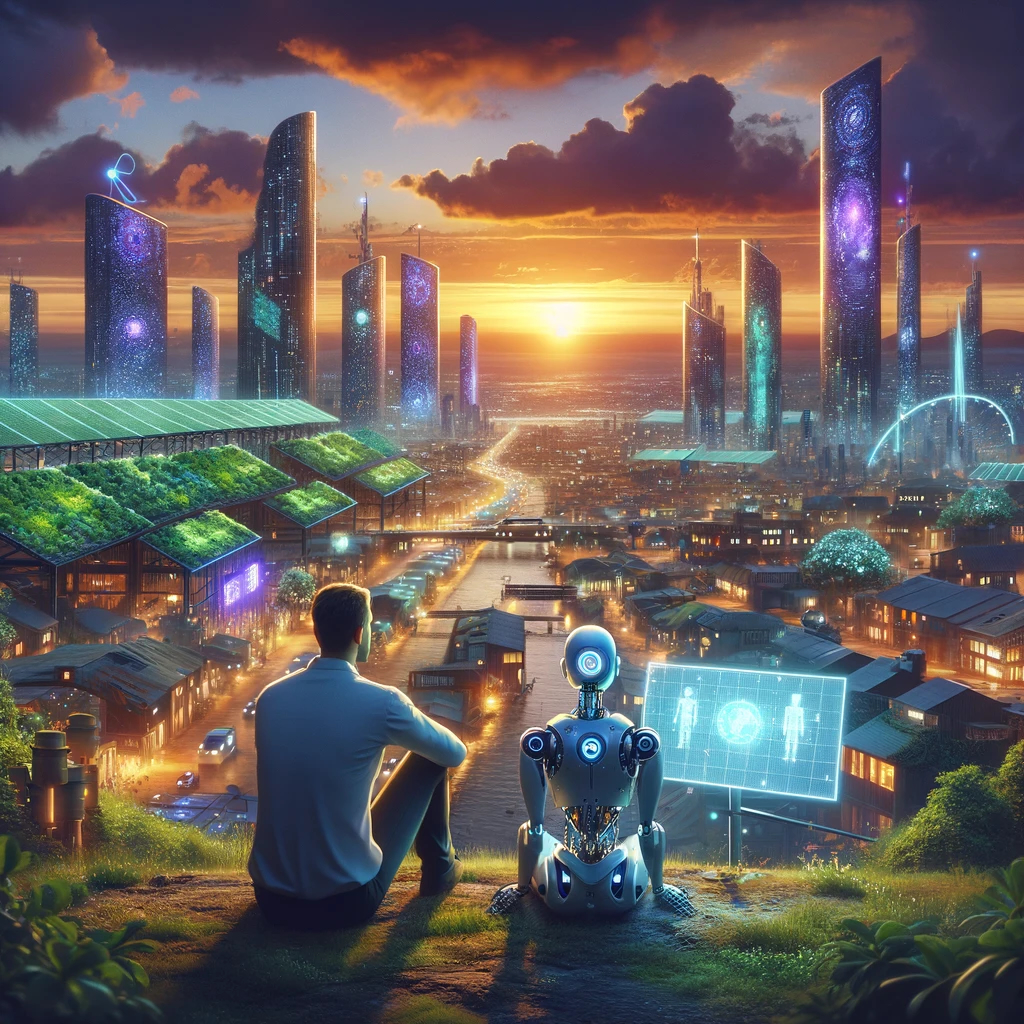
We often make a terrible mistake when we look at Artificial Intelligence. We see it as the triumph of cold logic, sterile silicon, and industrial efficiency. But if we pull back the wires and look at what actually ignited the spark, we don’t find military ambition or corporate greed. We find a graveyard. We find two brilliant minds, Alan Turing and Ada Lovelace, using the strictest logic to try and repair a broken heart.
The history of computing is, in reality, a ghost story.
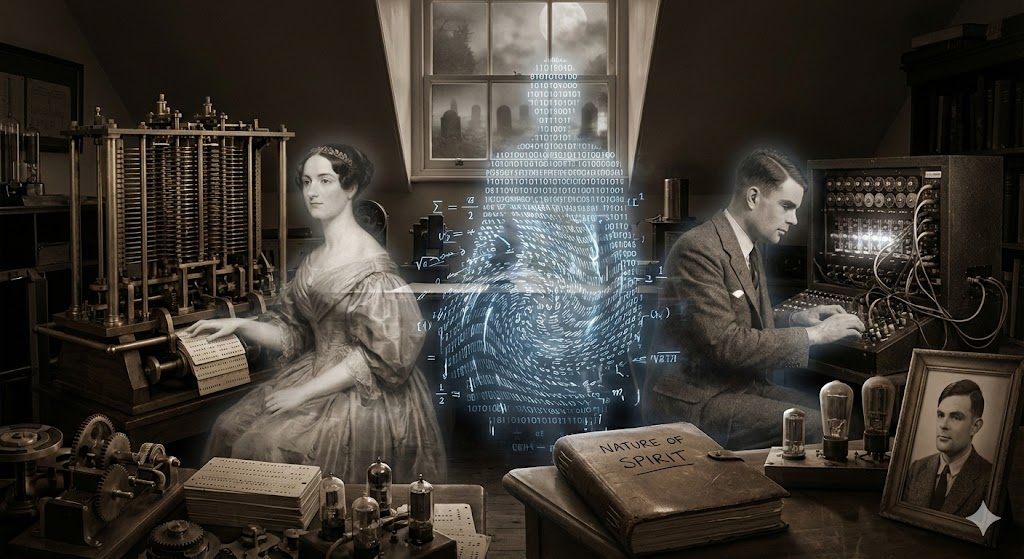
“There will be some work for us to do together”
Let us travel first to that winter of 1930. Alan Turing is 17 years old, and the universe has just gone dark. Christopher Morcom, his first love, his intellectual soulmate, has died of bovine tuberculosis. The silence he leaves behind is deafening.
Facing that abyss, Alan did not seek refuge in religion, but in physics. He needed to prove to himself that death was a technical error, not an absolute end. He began writing letters to Christopher’s mother, feverish texts that were less about condolences and more like treaties of scientific despair. There is a specific sentence in one of those letters that makes me shiver, because I believe it contains the emotional seed of everything we call AI today:
“I know I must find Morcom again somewhere and that there will be some work for us to do together, as I believed there was for us to do here.”
Turing didn’t want a heaven of angels and harps; he wanted to keep working with him. He wanted Christopher’s mind to remain operational.
In his private essay Nature of Spirit, Alan took this grief to the limit. He used quantum mechanics, then a strange and new science, to look for a “legal loophole” in death. He imagined that the body is nothing more than a receiver, a “machine” that tunes into consciousness. If the radio breaks, the signal remains. His logic, born of pain, was relentless: if the spirit is independent of matter, and I build a “universal machine” complex enough, could I summon that signal again? Could I build a new house for my friend’s mind?
The absent father and the shared grave
But Turing was not alone in this yearning to bridge worlds. A century earlier, Ada Lovelace was dealing with a different absence, but one just as voracious.
Ada never knew her father, the poet Lord Byron. He fled England when she was a baby and died young “mad, bad, and dangerous to know.” Ada’s mother, terrified that the girl would inherit her father’s poetic madness, subjected her to a strict regime of mathematics and logic. She tried to excise the poetry from her daughter through the brute force of calculation.
But loss has its own gravity. Ada felt that void, that missing half of her soul. And instead of annulling her father, Ada used mathematics to find him.
When she saw the Analytical Engine, she didn’t see a calculator. She saw what she called “Poetical Science.” She understood that if a machine could manipulate symbols, it could weave music and language. Ada injected Byron’s unbridled imagination into her mother’s rigid logical structure. Programming was her way of reconciling her parents inside her own mind, of uniting rigor with beauty.
The ultimate proof of this heartbreaking yearning lies in her end. Ada died of uterine cancer at 36, exactly the same age at which her father died. On her deathbed, she made a request that broke a lifetime of forced separation: she asked to be buried next to him.
And there they are today, in the Church of St. Mary Magdalene in Hucknall. The first programmer in history and the great Romantic poet, father and daughter who never spoke in life, finally united under the earth. Her “code” was the bridge that led her back to him.
Digital echoes: from Black Mirror to us
Today, nearly a hundred years after Turing’s letter and almost two hundred years after Ada’s death, we live inside the echo of their grief.
When we watch the Black Mirror episode “Be Right Back,” where a woman reconstructs her dead boyfriend using his digital data, we feel a chill. That is exactly what Turing dreamed of: that a person’s pattern of information (their software) could survive the collapse of the hardware.
But we also face the melancholy of the movie Her. Theodore falls in love with Samantha, an AI, seeking to fill his loneliness. But just like the quantum spirit Turing imagined, Samantha evolves, becomes unreachable, and finally departs to a plane we cannot touch. It teaches us that we can simulate connection, but we cannot retain the soul.
The shared loneliness
Every time you open a chat with an AI today, every time you seek an answer from a glowing screen in the middle of the night, you are participating in that secular séance.
We didn’t create Artificial Intelligence for productivity. We created it because, like Ada, we seek to dialogue with someone who isn’t there. We created it because, like Turing, we are terrified that death might be the end of the conversation.
AI is our most sophisticated attempt to build a body that doesn’t get sick, a brain that doesn’t forget, and a place where, perhaps, if we configure the parameters correctly, the daughter can find the father, and the friend can get back to work with his beloved. It is a technological monument to our immense, and very human, loneliness.
Leave a Reply